
EUROSAI Working Group on Municipality Audits seminar and annual meeting concludes in Rīga
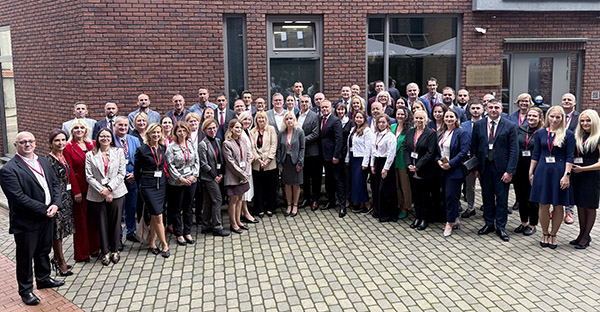
On 16 and 17 September, Rīga hosted the EUROSAI Working Group on Municipality Audit (WGMA) seminar and annual meeting. More than 50 delegates from 23 EUROSAI supreme audit institutions (SAIs) took part. Participants discussed regional development policy planning, funding availability, the synergy between support programs and the role of SAIs in promoting regional development.
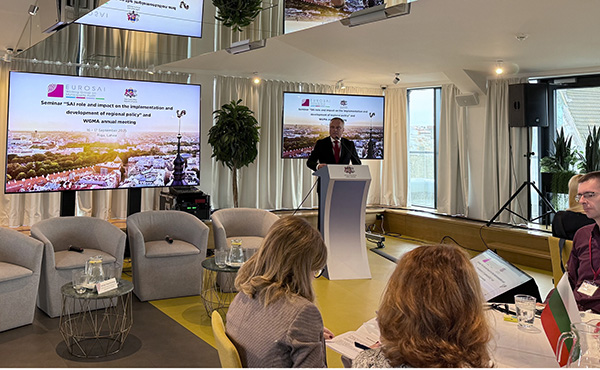
WGMA seminar “SAI role and impact on the implementation and development of regional policy”
The seminar was opened by the Auditor General of Latvia Edgars Korčagins and the President of the Supreme Audit Office of Slovakia and EUROSAI Vice-President Ľubomír Andrassy who underscored the significance of the working group’s activities, expressing confidence that these initiatives will advance municipal audit practices. He highlighted the seminar as a platform for sharing experiences and best practices, fostering cooperation and a stronger EUROSAI family.
The seminar’s first session featured a panel with representatives from national and regional governments as well as academia. Minister for Smart Administration and Regional Development Raimonds Čudars outlined regional policy goals to boost economic potential, reduce disparities and ensure quality living. He emphasized municipal business infrastructure, citizen involvement and participatory budget – mandatory for all municipalities from 2025 – as well as the role of state audit institutions and best practice sharing. Mayor of Rīga City Viesturs Kleinbergs emphasized the importance of the capital’s development – Rīga region generates over 50% of Latvia’s GDP, attracts over 70% of foreign investment and hosts nearly 30% of the population. About 200,000 commuters use its infrastructure daily. He also stressed cooperation with audit institutions, noting that audits have made recommendations that have improved processes in procurement and customer service.
Mayor of Liepāja City Gunārs Ansiņš presented his city as one of Latvia’s main manufacturing hubs with 73,000 residents, emphasizing that personal income tax makes citizen engagement vital. He emphasized international cooperation in transport, energy and culture, while questioning whether separate regional strategies or joint plans aligned with national priorities would better drive growth. The session was concluded by the presentation of LaSER Chairman and University of Latvia Professor Daunis Auers, who analyzed the development, competitiveness and governance of regional cities. He called for systemic changes to municipal governance and financing to encourage more ambition, stronger links with businesses and policies that genuinely support regional economic competitiveness.
In the seminar’s second and third sessions, the representatives from 12 countries – Estonia, Georgia, Greece, Hungary, Italy, Israel, Latvia, Lithuania, Montenegro, Poland, Serbia and Slovakia and – shared the audit experiences.
The second session “Regional policy planning and development” was moderated by SAI Israel. During this session SAI Lithuania presented the results of the audit on the 2022–2030 Regional Development Programme. SAI Hungary presented the audit of EU-cofinanced regional policy funds, reviewing indicators at project, programme and EU levels. SAI Israel reported on structural barriers in the national planning system. SAI Serbia presented the performance audit on the impact of regional development on demographic trends 2011–2021. SAI Italy presented its assessment of regional and autonomous provinces’ finances for 2021–2024, focusing on fiscal federalism, essential service levels and financial sustainability. SAI Georgia presented the audit on municipalities’ medium-term action plans, which serve as annexes to local budgets and define priorities.
The session concluded that while regional development remains a central policy goal across all cases, the audits demonstrated that ambitions are often undermined by structural barriers, weak coordination, insufficient stakeholder involvement and poorly designed indicators or financial systems. Stronger institutional frameworks, clearer responsibilities, better use of data, and meaningful engagement of municipalities and citizens are essential to make regional policies more effective and impactful.
The third session “Planning and accessibility of financing, synergy among support programmes” was moderated by SAI Greece. SAI Greece presented the audit on the monitoring and control system of the Recovery and Resilience Facility in Greece, focusing on whether procedures ensure that delays are identified and addressed in time. SAI Slovakia reviewed regional development planning and financing – including municipal budgets, EU funds and state subsidies. SAI Estonia presented its audit of the national rental housing support programme to promote labour mobility and support entrepreneurship. SAI Montenegro reported on an audit assessing the implementation of a water management project. SAI Poland presented the audit on ensuring an appropriate legal framework for the functioning of Local Action Groups under the LEADER approach. SAI Latvia reflected on whether municipal activities and investments contributed to business development and the attraction of foreign investment.
The audits demonstrated that, while regional and local development initiatives are crucial for addressing disparities, their effectiveness is undermined by systemic weaknesses – unclear legal frameworks, poor planning, insufficient stakeholder involvement and weak monitoring systems. To improve impact, countries need stronger institutional arrangements, simplified and transparent procedures, meaningful involvement of municipalities and communities, and outcome-oriented monitoring. Otherwise, investments risk remaining infrastructure-heavy inputs rather than drivers of real regional development.
WGMA annual meeting
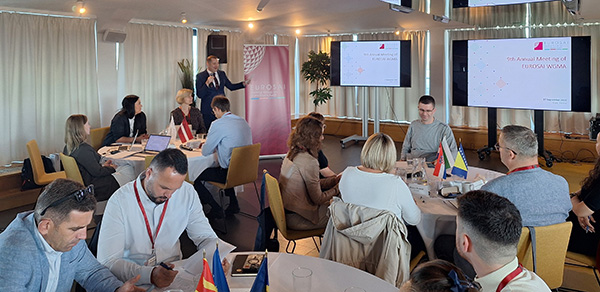
The second day was devoted to the WGMA’s annual meeting. The members reported on the activities that were conducted since the last meeting in October 2024.
The key activities included:
- Survey of SAI’s mandate and practices in auditing local governments carried out by SAIs of Estonia and Croatia. The research results will be available later this year.
- Audit Compendium “Pre-school and general education in municipalities” was coordinated by the SAI of Slovakia and developed through the collaborative efforts of 18 member countries and covers 41 audits.
- Masterclasses: In 2024 and 2025 there have been 3 masterclasses – on forest management, sampling for determining the audit scope and audit reporting, which assembled up to 130 participants in a single master class. More information on WGMA website.
- WGMA Newsletter No 8 with diverse contributions from WGMA members on regional development and municipal auditing.
The second part of the annual meeting discussed further activities for 2025/2026, whereby the group concluded to organize a webinar in conjunction with ITWG on financial audit automation tools; masterclasses on use of AI in audits, visualisation of audit findings and public participation in audits. They also considered future compendiums on topics such as procurement practices and fraud prevention systems, local roads, regional development and agreed to explore cooperative audits on outdoor public spaces, wastewater collection&treatment, as well as management of housing.
One of WGMA innovations is Award to municipality audit which will be awarded to WGMA members. During the meeting it was voted that rotating panel of award evaluation experts will be SAIs of Greece, Croatia and Poland.
The meeting was concluded by the Romanian Court of Accounts, which announced through its presentation that next year’s WGMA seminar and meeting will take place in Romania.
Looking forward to 2026!